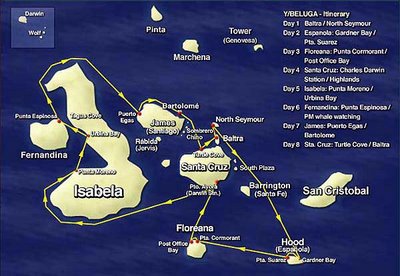
Sunday, October 29, 2006

Tuesday - Isabela

Punta Moreno
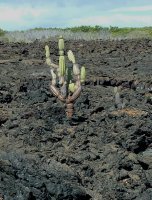
On Tuesday morning, we arrived at Punta Moreno, on Isabela. During the briefing before landing, Mauricio warned us that this would be a dry landing on very jagged and uneven lava. (The boulders on Espanola would seem easy compared to this.) As the pangas pulled up to the island, I wasn't even sure how I was going to scramble up the cliff. Usually there is something that at least resembles steps - this time - no. I almost considered getting back into the panga and going back to the yacht, but it was even scarier turning around than going up. Once I reached the top, I looked out and saw a vast expanse of the same rough, brittle, pahoehoe lava. In my mind, walking across lava was going to be like walking across blacktop with lots of cracks. Boy was my mind wrong!

After a few minutes of struggling with trying to figure out where to step, Mauricio decided that it would take a month for me to walk the trail on my own. He told me to grab his hand and stay to his right, and he would lead me through the trail. On one hand I was very thankful that I had his help, but on the other hand I kind of felt like a dork. Like a blind dork. I even commented that I felt like I was blind, with him leading me by the hand and my walking stick clicking against the lava in the other hand.
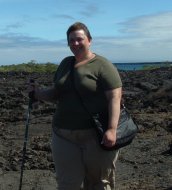
There were a few areas where the lava flattened, but most of the time, my ankle and knee were at weird angles. There were also quite a few ledges and crevices. The crevices usually weren't more than a foot wide, although they were really deep.
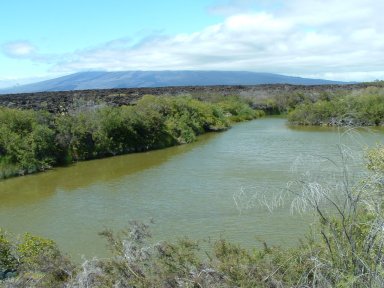
The ledges were on edges of cliffs filled with sharp pointy lava - and sometimes pools of brackish water filled with sharks! Mauricio kept steering me towards the ledges and I kept trying to follow behind him, rather than beside him. Every now and then he would "yell" at me for not walking where I was supposed to, since he claimed the edge of the ledge was more solid than where he was walking. I knew I should trust him, but I really didn't want to end up at the bottom of one of those cliffs!

While there wasn't that much to see on the surface of the island (a few small plants and cactus), there was a lot to see at the bottom of the cliffs. Those areas often filled with brackish water (salt water from the ocean running up fissures in the lava, and fresh water running down from the volcanoes). Small fish and sharks would get into these pools through the fissures with the salt water, then grow too big to escape back to the sea, getting trapped.
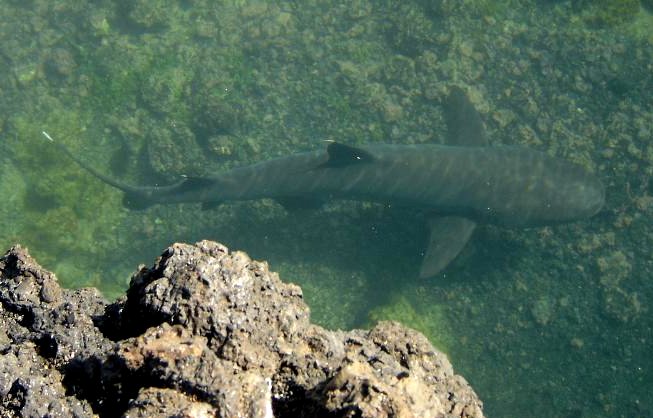
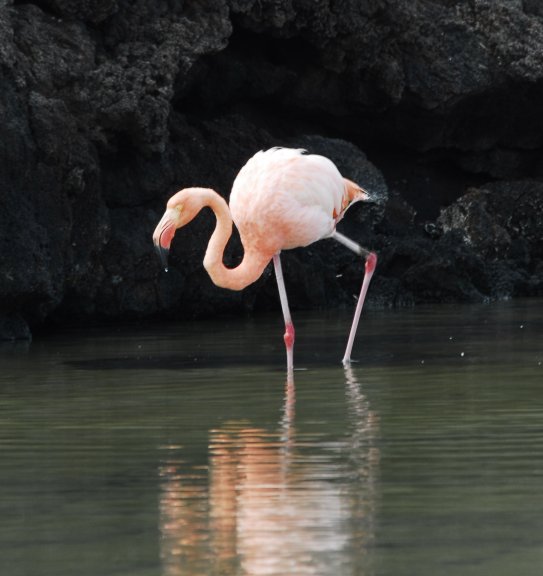
Lots of plants grew along the edges of these pools, and the water attracted flamingos, stilts, martins, and other shore birds.

After the walk was over, came the part I was dreading the most. Getting back down the cliff and into the panga. My descent was less than graceful, and I basically fell into the boat. I can't begin to tell you how happy I was to get back on the yacht!

After we were all back on the Beluga, the captain turned on the engine and we started moving to Elizabeth Bay. We ate lunch while the yacht was moving, which was quite an experience in itself. Most of the time, meals were served when the yacht was anchored.


Elizabeth Bay, Isabela
Shortly after lunch, we dropped anchor and went snorkeling at Elizabeth Bay. There were a couple of penguins zipping by, but they were very difficult to capture on film. There were also a few flightless cormorants, which were equally quick swimmers. As we moved closer to the rocky/lava shoreline, there were all sorts of inlets to explore.

There was one narrow channel that led to smaller pools surrounded by lava. Getting through that was difficult, since the tide was going out, and you really had to swim against the current (and push off against the rocky bottom). Once it that area, there was a mix of brackish water - it almost looked like we were snorkeling in oil, since the mix of fresh and salt water caused a filmy cloud. This made taking pictures rather difficult.

As we moved further inland, there was one area that Mauricio told us not to miss. He made it all very mysterious, saying that we couldn't wear our flippers or kick our feet in that area, and only 3 people could enter at a time. He then swore the leaving people to secrecy, so they couldn't tell anyone else what they saw. In order to get into this area though, you needed to take off your flippers, and walk about 3m across the same sharp, uneven lava that we walked across earlier in the morning. Sheesh! I could barely walk across that with shoes - let alone barefoot. Several other people were equally hesitant to walk across that lava, so we problem solved and made a path with our flippers. That way, even though the sharp lava was underfoot, our feet were actually touching the rubber flippers. Mauricio assured us it was worth the effort. IT WAS! In addition to all sorts of fish, there were about a half dozen sea turtles in an area about the size of my bedroom, gracefully swimming along beside us. What an incredible experience.

After hauling ourselves back out of the water and into the pangas, we headed back to the yacht for a warm snack and to change clothes. We had about an hour to dry off and warm up, before we hopped back into the pangas for a ride through the mangroves. The crew also brought the kayaks out, so people could use those if they wanted (there were 2 kayaks for everyone to share).

It was amazing how close we could get to the wildlife in the pangas. Once we got into the mangroves, the motor was cut and the driver pulled out oars, so we could paddle silently in the water. Through the water, we could see sea turtles and a few sting rays, but the real interest was on the shore.
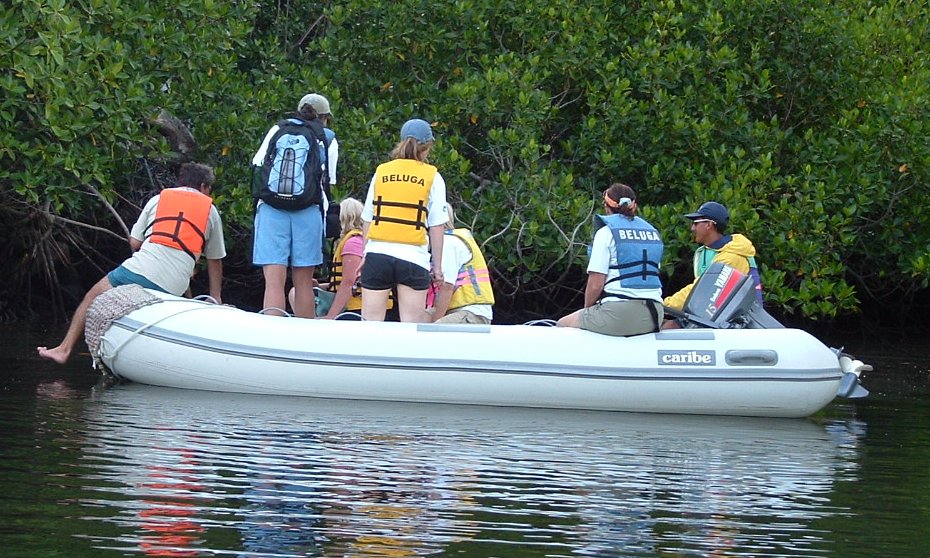
At one point, we came across a group of penguins on the shore. I was close enough that I would have been able to touch them! In fact, I ended up holding onto a branch of the tree they were under in order to keep the panga still, and stop it from bumping against the shore with each wave. It was amazing to see the amount of wildlife hiding in the mangroves. There were pelicans, sea lions, and lots of different kinds of shore birds.


We also stopped for a while to watch heron catching small fish.
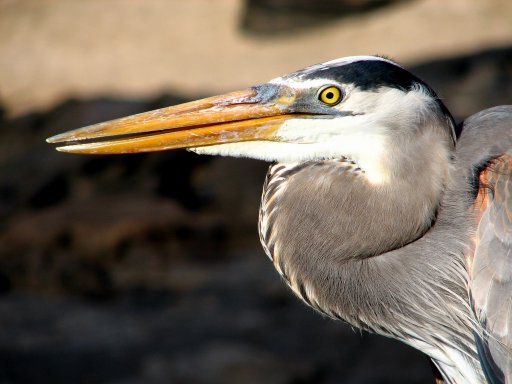
There were several kinds of heron present.


As the sun was starting to set, we left Elizabeth Bay and headed back to the ship, where George was waiting for us with hot appetizers and drinks. Most of us got a glass of wine and went up to the sun deck to relax before dinner and enjoy the view of the setting sun. And we were rewared with a spectacular sunset!

Wednesday - Isabela and Fernandina

Urvina Bay - Isabela
You can't even imagine how relieved I was to learn that the trail today was going to be easy! In fact, we were told that it was going to be so easy that we could even wear flip flops! I decided to play it safe and wear the tevas, since I would probably kill myself in flip flops. After the wet landing on the beach, we dried our feet and started on the trail. This was a nice easy trail, consisting mostly of sand or small gravel. There were a few rocks interspersed, but most of it was relatively flat and smooth.

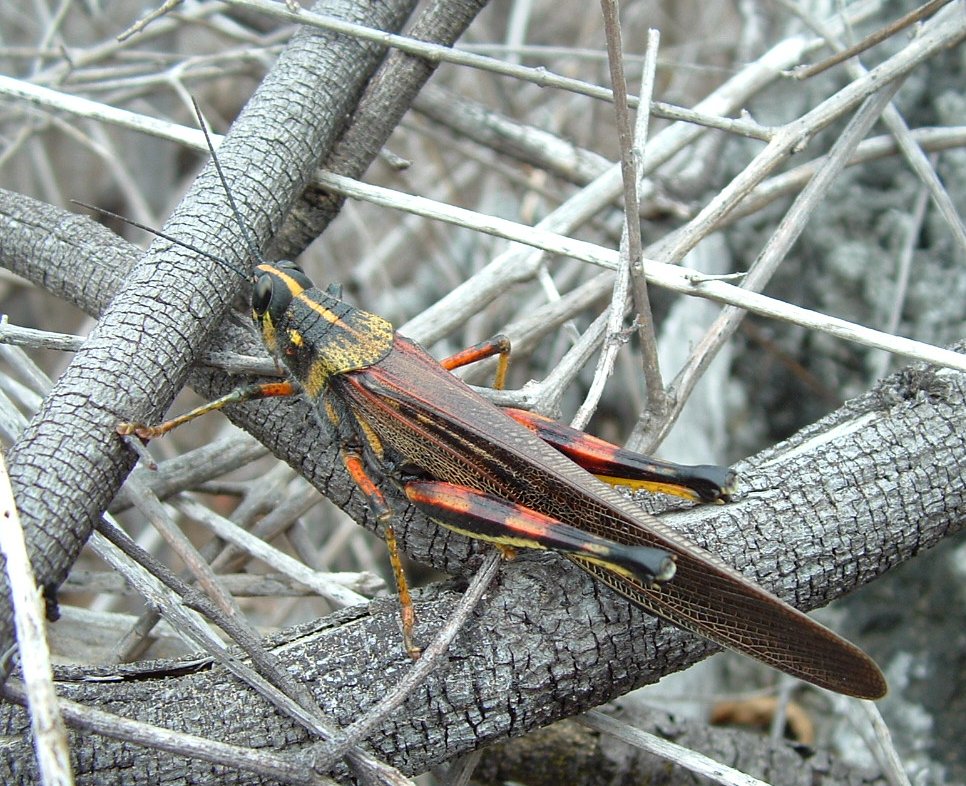
Along the trail painted locusts hopped in and out amid the arid vegetation. One of the first trees we encountered was the Manzanillo tree (poison apple). The fruit of this tree resembles a small apple, but is highly toxic, resulting in stomach cramps if eaten. In addition, the sap in the leaves, can cause burning and blistering of the skin and eyes. We were warned that it was much worse than poison ivy.

The first time we encountered this tree was actually at the Darwin Research Center. We had stopped to look at finches, and as we waited, Klaus got antsy and started playing with a nearby tree. When Mauricio saw that, he nearly lept across the trail and tackled Klaus, and then warned all of us not to touch that type of tree. We all laughed - Klaus had a way of getting into things!

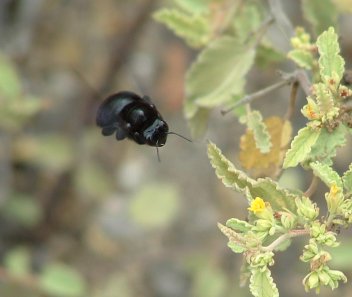
There were also some nice yellow flowers along this path, which attracted quite a few carpenter bees. Mauricio also told us a story about galapagos cotton which grew there (and how the genes were being used for some type of hybrid cotton), and said something about how cherry tomatoes were a result of selective breeding between traditional tomatoes and a Galapagos tomato. He then went into a long speech about how the Galapagos was being exploited for the genes of some of the plants and animals, but Ecuador was not being compensated for this "gift" to the world. I'm not quite sure how accurate this information was.

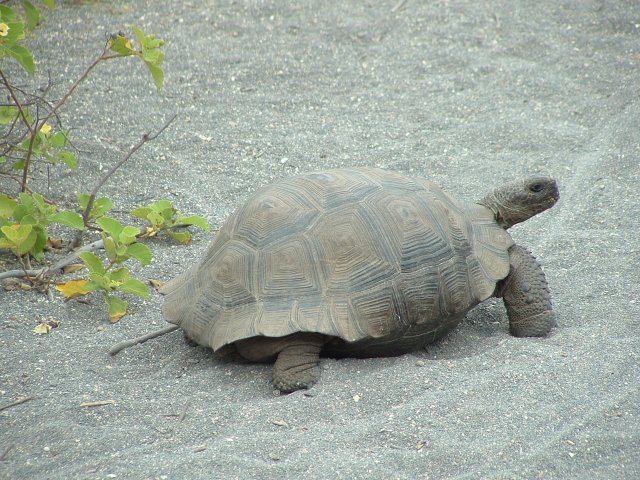
Not too far along the trail, we spotted a tortoise in the path. Woo hoo! I got to see a wild one! Now I don't feel so bad for missing the walk through Santa Cruz's highlands on Monday afternoon. It was a small one - probably only around 7-10 years old, but wild nonetheless. We probably spent a good 15 minutes standing and staring at it, although it didn't really do anything. As we approached it, it pulled its head into its shell about half way. After about 10 minutes, it poked its head back out, then wandered off into the vegetation on the side of the trail.

A little further along the path, there were a few land iguanas. As we came around the bend in the trail, the amount of vegetation really decreased, and we saw a land iguana digging a burrow. We spent another 10 minutes or so watching it dig the burrow.
We walked further down the trail to a lagoon. We had hoped to see rays and sharks, but didn't have any luck in that regards.

We were able to see a few shore birds, but there wasn't much in that area other than mocking birds and finches. Each time somebody pulled out their water bottle for a drink the mocking birds would fly in closer, hoping to steal a drink. Unfortunately for them, none of us were willing to share.

Fernandina - Punta Espinosa
During lunch, the yacht headed to Punta Espinosa on Fernandina Island. We were told that this would be a dry landing, with a fairly easy trail. Because of the tide (and my clumsiness), we landed in the mangrove area rather than on the lava outcroppings. I was quite happy with this landing. There were nice concrete steps at the mangrove, and after chasing the sea lions off of them, the landing was very smooth!

After a short walk out of the mangroves, we reached a sandy area surrounded by nesting grounds for marine iguanas. Mauricio stressed how important it was to stay within the boundaries of the trail markers, so we didn't accidentally step on or destroy and iguana eggs. From the numbers of iguanas that were there, I'm not sure it really would have been a problem if we had! There were thousands!

As we were starting to take pictures of the iguanas (and more sea lion pictures) we spotted a Galapagos Hawk further down the trail. Mauricio told us to see the hawk while it was still there. We were able to walk within about 10 feet of it (and a sea lion was peacefully slipping at the base of the tree where the hawk was perched).

On this island more than any, you could really see how multiple types of animals all shared the same living space. It was amazing to see iguanas, sea lions, crabs, hawks, and flightless cormorants all right next to each other -without anyone attacking anyone else! Absolutely incredible! Even more incredible was that humans were added to that mix!

At this point, the trail turned from gravel to lava. This was the kind of lava I expected yesterday. There were big (mostly) flat slabs of lava, resembling walking over flagstone or across asphalt that barely survived expanding and contracting over a particularly rough winter. You had to watch where you were going so you didn't stub your toe, but you didn't have to worry about twisting an ankle. This is my kind of lava!

The highlight of this island was the flightless cormorant. When I originally booked my cruise, I decided that I would rather go to Genovesa and see the red footed boobies, than go to Fernandina and see the flightless cormorants. While I still am disappointed that I didn't see any red footed boobies, I think the afternoon on Fernandina was one of the most spectacular visits during the cruise (at least so far). Words can't even describe how incredible it was to watch the cormorants dive into the water, then get back out and dry out. They went through this little ritual of drying their small atrophied wings. Watching them thermoregulate was also interesting. In their beak, they would have a little water bubble, and then they would pant. It was quite interesting.

The island was absolutely beautiful. There was black lava, white sand, blue sky, green mangroves. There were lots of interesting animals, including frigate birds and blue footed boobies, hawks, crabs, cormorants, sea lions. There were interesting geologic formations, including some giant uplifted areas. There was even an old whale skeleton on the beach.

Once we were back on the ship, they immediately started the engine, since we were going to go up and around Isabela tonight. In doing so, we would cross the equator (twice). To celebrate the crossing of the equator, we all crammed into the bridge so we could see the GPS change from 0.00.00 degrees S to 00.00.00 degrees N. Woo hoo! We celebrated with a rum and tonic (blech!). Good thing we don't have to repeat it when we cross back in about 6 hours. Actually, we were treated to quite a nice sunset in the process and saw a few whale spouts and a few sunfish.

Each day, Mauricio ended the evening briefing by stating that "tomorrow will be even better than today".

This was the first night that I went to bed wondering how that would be possible!

Thursday - Santiago and Bartolome

Santiago - South James Bay
This morning we woke up to the Garua mist, which by the time we finished breakfast had turned into a fast drizzle of rain. We put on our rain gear and hopped into the pangas for a wet landing on the black sandy beach of Puerta Egas on Santiago Island (Also known as South James Bay). After landing on the wet sand, we walked up a slight hill that took us off the beach. The trail followed the black lava coastline, filled with algae covered grottos and tidal pools.

We had the option to walk at the coastline, over the wet slippery lava, or to stay a little further in the shore, where the lava was flatter and while wet, was not algae covered. I picked the latter. The two trails often overlapped at the flat lava areas, so it wasn't as though I was on my own. In fact, I felt like I had the best of both worlds. I was closer to the grassy areas further inland, so I saw lots of finches, yellow warblers, and Galapagos doves. Plus, I could wander onto the lava (just not all the way to the very edge) to see the lava herons, oyster catchers, and Galapagos fur seals. Within the little lava outcroppings were small blowholes (nothing as grand as on Espanola Island). There was one area that Mauricio called "Darwin's Toilet". The water would fill a rather large hole in the lava, then get sucked out again, making a flushing noise.

As we were leaving the shoreline and walking further inland, the mist started to lift and we could see the rest of the island better. This part of the island was very arid, with lots of palo verde trees, acacia, candelabra cactus, and lava lizards. We flipped over a few rocks and found lots of Galapagos scorpions.

After a nice walk back, the mist started rolling in again. That was ok, because our snorkel gear was waiting for us on the beach. All of the crew came over to the island to play soccer, and brought our gear with them. It didn't matter if it rained while we were in the water.

Despite the rain and waves, the visibility in the water was pretty good for snorkeling. Because it was overcast outside, there wasn't glare on the screen of my underwater camera, and I could actually see what I was trying to photograph. I think I got some of my best snorkel pictures this morning. I was engrossed with watching fish and a large green sea turtle for a while and kind of lost perspective of what was around me.


Suddenly I heard a loud barking in my ear. A male sea lion's mouth was less than a foot from my head, and he didn't seem like he was in a good mood. I backed away from him, freaked out, and headed back to shore.


I used the rest of our snorkel time to explore the beach from dry land!


Bartolome
After snorkeling, we headed back to the yacht for hot soup and lunch. We were told not to unpack our snorkel gear because we would be snorkeling off Pinnacle Rock after lunch. This would be the last snorkel of the trip.

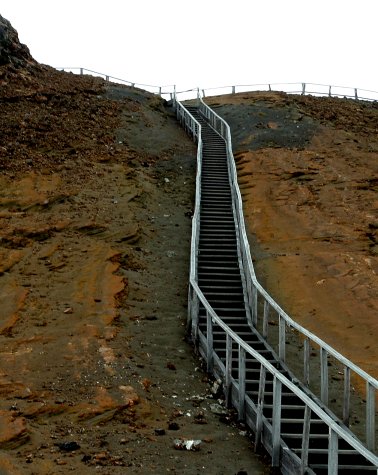
But first, we had a dry landing on Bartolome. The surface of Bartolome is covered with a delicate crust of volcanic ash and very small, low ground cover plants called tequilia. In order to minimize erosion and damage to the island, a wooden boardwalk was built that creates a path most of the way to one of the summits on the island. This boardwalk consists of approx. 350 steps. The last 50 or so steps have a railing that is really really low (about mid-thigh height), which makes it very difficult to use the railing. After walking up to the top of Bartolome, you are rewarded with this spectacular view!

After going back down all the steps, it was back to the boat to change into snorkel gear. We then headed to snorkel on the back side of Pinnacle Rock (the large pointy rock formation on the right side of the picture). One of the bigger (100 passenger) cruise lines was there are the same time, so you were more likely to see another snorkeler than anything else. There were a few penguins in the water, and some sea lions, but the visibility was not all that good. This probably wasn't the best snorkel to end with!

I caught a chill, and it was back onto the boat for some hot tea. We had a great goodbye dinner, and were given instructions for the next morning. Instead of heading out after breakfast, our excursion would be at 6 am! Almost everyone called it an early night to pack and get some sleep.

Friday - Tortuga Negra, Santa Cruz

Tortuga Negra (Black Turtle Cove)
This morning we all got up early and piled in the pangas for the final Galapagos Adventure. We were going to ride through the mangroves at Black Turtle Cove and not have any landing. I wondered how it was going to be different than the panga ride through the mangrove at Elizabeth Bay, and thought this was probably a wasted day.

I couldn't have been more wrong! One of the first things we saw was an early morning feeding frenzy of blue footed boobies. There were 100s of them - maybe 1000s!! They moved as an entire flock, then dive bombed the water. After a minute or two, the flock would fly to another nearby area of the cove, and dive again. Watching the blue footed boobies dive is amazing. They pull their wings in close to their body and dive straight down, like a torpedo or bullet. A few times I nearly had to duck as the flock flew over us, and I was hit more than once with the water from their splash. Being caught in this swirling mass of diving boobies was one of the highlights of the trip!


As the sun came further up, the flock of boobies broke up, with a few remaining in the area, but many heading far out of our sight. We then continued through the mangroves, spotting lots of animal life under the water. One person on the other panga spotted a sea horse. We all tried to crowd around and see it, but I never got a good look at it.


Also under the surface of the water were lots of sea turtles, white tipped reef sharks, a couple of sting rays, and more impressively, a large group of golden cownose rays! They were absolutely beautiful as the glided through the water. I was really happy that I brought my polarizing filter with me!

As we slowly paddled through the cove, I spotted a few pelicans. One of them happened to be sitting on a nest with a chick. I don't think I've seen a pelican chick before, so this was a special goodbye treat.

After about an hour and half, it was back to the Beluga for breakfast and to make one last pass at my cabin to make sure everything was packed. Then we climbed into the panga one last time for our final trip to shore. I must say, I'm not going to miss having to get in and out of the panga!

Once on shore, we waited for the bus to pick us up for the airport, and the crew followed with our bags. We checked our bags at the airport, got a special Galapagos Island stamp in the passport, and had about an hour to shop for trinkets before heading back to Quito.

What a great trip!!

Saturday - Quito

I arrived back in Quito on Friday afternoon and took a taxi to my hotel. I got the same room as I had a week earlier. I spent most of the rest of the afternoon taking a much needed nap, and then wandered around the Mariscal district (gringo Quito) for the rest of the evening. I decided to have dinner in an Italian restaurant a few blocks from my hotel, and walked in to find Hildegard and Klaus. I joined them at their table and we had a nice dinner. They then walked me back to my hotel, since it was on the way to theirs.

On Saturday, I debated whether to catch a bus to Mindo for the day or even Otovalo. Instead, I decided to check out the market at El Ejido park. When I got there, I wasn't in a very shopping mood, and wandered around for a while, but really didn't feel like dealing with the crowds or looking at stand after stand of practically the same stuff. There were a few nice paintings, but they wouldn't have fit my decor, so I wasn't really interested in them.

Since Carolina Park was fairly close, I hopped in a cab and headed over there to visit the botanical gardens. The park was huge, and the gardens were on the opposite side of the park from where the cab dropped me off. I'm glad I didn't tip him!

As I walked through the park, I watched a dog obedience class for a while. There were also several exercise classes going on - aerobics, T'ai chi, etc. Despite all the families and activity in the park, there were also quite a few people that looked unsavory. I felt a little uncomfortable walking through the park alone. In fact, I had that general feeling of discomfort througout Quito.

Once I found the entrance to the gardens, I paid my $2 admission and went in. Once inside, I felt a little safer. I decided that a criminal would probably mug somebody in the park for free, rather than pay $2 to do it in the garden (and then have to pass security on the way out).

The gardens were fairly small, but had quite a bit of diversity, and were nicely laid out. One of the highlights of the garden is that it houses 1200 orchid species, along with representative plants from a half dozen ecosystems in Ecuador.

There were lots of benches so you could sit and enjoy the plants and birds. As I was taking a nice break and just enjoying the gardens, I saw the weirdest looking bird. It looked a lot like a large humming bird, but had a tail nearly three times its body length. It was difficult to take a picture of, but I got a quick shot of it when it stopped to drink out of a puddle (see pink square in the picture).

I think it is either a black-tailed trainbearer or a green-tailed trainbearer. These links take you to better pictures than what I took. Just seeing that bird was pretty cool and worth the trip to the gardens!

After leaving the gardens, I headed back to my hotel for a late afternoon nap. After waking up, I walked a few blocks for an early dinner. My flight was at 6:30 the following morning, so I needed to call it an early night and get everything packed and ready to leave the hotel by 4:00 am. The next morning, I said goodbye to Ecuador.

[I finally edited my Day 1 in Quito entry to include pictures of historic Quito]

Saturday, October 28, 2006

Galapagos Summary and Tips

One of the greatest challenges when booking a Galapagos trip is figuring out which islands to visit. In part, this is going to vary by the time of year. Which animals do you want to see? Do you want to see them in mating season or with newly born young? Do you need to snorkel in warm water or could you handle the cold water? (You don't want to miss snorkeling!)

During my trip during late September / early October, I knew I was missing most of the young of the blue footed boobies, but I was there in time to see the mating rituals of the waved albatross and the frigate birds.

Below are the islands I visited and the animals that I thought were highlights of each site:

North Seymour

  • frigate birds and swallow-tailed gulls
Española

  • Gardner Bay - sea lions, sally lightfoot crabs
  • Punta Suarez - waved albatross, nazca boobies, red-billed tropic birds, marine iguanas (bright red and green), mocking birds
Floreana

  • Punta Cormorant- flamingos, sting rays
  • Post Office Bay - horse flies, snorkeling with sea lions
Santa Cruz

  • Puerta Ayora - tortoises at the Darwin Research Center, finches
  • Highlands - wild tortoises
  • Tortuga Negra - blue footed boobies, golden cownose rays, pelicans
Isabela

  • Punta Moreno - flamingos, white tipped reef sharks
  • Elizabeth Bay - sea turtles, penguins, herons
  • Urvina Bay - land iguanas, painted locusts, mocking birds
Fernandina

  • Punta Espinoza - flightless cormorants, galapagos hawk, marine iguanas
Santiago

  • South James Bay - fur seals, galapagos scorpion, yellow warbler
Bartolome

  • penguins

General Tips:

  1. Read as much as you can about the animals and geology of the islands before you go. That way you already have an idea of what to look for on each of the islands and what it looks like. While the guide was pointing out animals for much of the rest of the boat and telling them about the biology/ecology of those animals, I was able to half listen and concentrate on getting better pictures. Plus, I didn't need to write down that slide #243 was a nazca boobie, because I was already able to identify it.
  2. Selecting your yacht can be a daunting task. You have to balance the itinerary you want with the cost, level of comfort, and availability. Even after doing that, be prepared to be flexible, since your yacht and itinerary is still subject to change (weather, mechanical issues, or "lost" reservations).
  3. On the smaller yachts, "luxury" really isn't luxury. I went on the "luxury" yacht Beluga. The Beluga was clean, comfortable, served excellent meals, and provided good customer service. However, the cabins were still very small. Only soap was provided (no shampoo or other toiletries typically associated with luxurious accomodations). The only reason this really stands out to me is that I accidentally packed a container of body wash, rather than shampoo. I noticed this the first day in Quito, and decided not to buy a small bottle of shampoo because I was sure that my luxury yacht would provide some. I was wrong. I spent the cruise washing my hair with body wash and soap - although not a big deal, it is something to know.
  4. While the trails are fairly short (typically 1-2 km) and relatively flat, the terrain can be very uneven and rocky. If you have weak ankles or balance problems, be sure to bring sturdy shoes and even a walking stick. I found both to be very useful.
  5. You also need to be able to get in and out of the pangas. You will do this multiple times a day - from the yacht, to the island, from the island, to the yacht, and often times in/out at open sea while snorkeling. Sometimes the waves are quite rough, so again balance is required. If you are clumsy or heavy/fat, inflatable zodiacs are more stable than "canoe shaped" boats. Just something else to consider when booking your yacht.
  6. If you visit August - October, the water will be cold. You don't want to miss snorkeling, so a wet suit comes in very handy (it is a necessity if you can't handle cold water). You will want to check to see if your yacht rents wet suits and snorkel equipment. If not, you will want to provide your own. If you are a difficult size to fit (especially very large), your yacht may not have anything that will fit you (or if you need a prescription lens in your snorkel mask). Be prepared and bring your own. It's worth the extra cost and effort, so you don't miss snorkeling.
  7. Bring lots of sunscreen and use it EVERYWHERE. Make sure to get your feet, back of legs, ears, neck, and even top of head if you don't wear a hat or have thick hair.
  8. Most important, bring your sense of humor. Being in close quarters with a dozen or so strangers for a full week can be a challenge if you aren't willing to go with the flow and laugh once in a while.

Monday, September 25, 2006

Galapagos Planning: T minus 2 days and counting

I'm finally starting to get used to the idea of the new itinerary. I went to the library yesterday and looked up a couple of books on the Galapagos that had a lot of pictures. The following two books had some spectacular pictures.


"The Galapagos Islands" by Pierre Constant 2006


"Galapagos, islands born of fire" by Tui De Roy 1998


Some of the most spectacular pictures were taken on Fernandina and Isabela, although I'm not sure they were from areas that I will actually see. Hopefully I will at least see some of the spectacular scenery.


The other thing that is making me a little happier with the itinerary is that currently is appears as though I may have a room to myself on the Beluga. When I look at ship availability for my dates, there currently shows 1 berth available and noted with female share, last minute rate.

Tuesday, September 19, 2006

Galapagos Trip - Planning

Bumped into an "upgrade" 

Back in May, I booked a Galapagos Island cruise on the yacht, Fragata, which was scheduled to leave later this month. Today, I received an email with the following information:

Due to an unintentional error on behalf of the operator of the Fragata, they have upgraded you to the Luxury class motor yacht, Beluga! For more information on this yacht, feel free to go to http://www.enchantedexpeditions.com/yachts_beluga.htm

While the "new" yacht is probably nicer than the Fragata (it costs more than 2X that of the Fragata), I didn't pick the cruise based on the yacht. I picked it based on the itinerary. With the Fragata, I would visit Genovesa, Santa Fe, and South Plazas islands. The Beluga does not go to any of these three islands! Instead, it goes to Fernandina and a couple of places on Isabela islands.

I'm sure these are very nice, but I spent weeks researching the different islands and which animals I wanted to see. I was willing to pass on seeing the flightless cormorant (on Isabela) to see the red footed boobies, red-billed tropic birds, and short eared owls on Genovesa. (I can see the latter two birds on some of the islands that remain the same for both itineraries, but they aren't as "easy" to find on those islands as the ones I am giving up) Both Santa Fe and South Plazas are excellent places to see land iguanas. I'm not sure I will see them on Isabela.

While I'm sure that I will have a great time once I'm there, I can't help but feel extremely disappointed that the trip I invested a great deal of thought into planning (and paid for months ago) was drastically changed so close to my departure!


Bank robbery? 

 I went to the bank today to get cash for my trip to Ecuador. There were several 'unsavory' looking people in line, so I decided to write down the amounts of each denomination that I wanted, rather than being overheard talking to the bank teller. I found a piece of paper in my bag, and wrote down that information, then at the top of the page scrawled "Crisp Unmarked Bills!"

I then wrapped that piece of paper around my withdrawal slip, bank card, and driver's license. When I got to the window, I slid the whole thing under the glass, oblivious that the only thing he could see was
Crisp Unmarked Bills!

It took me a split second to realize why he had a look of panic on his face and then I quickly corrected the looming problem by telling him to unfold the paper - that my ID and withdrawal slip were inside. He chuckled and told me that "unmarked bills" is a term that I should avoid during future trips to the bank. D'uh!

That problem solved, the teller tried to fulfill my request of a specific number of each denomination that was crisp, clean, and free of any tears or extraneous markings. He had to dig through several tellers' drawers in order to find enough bills that fit the order. Finally he got everything I needed, and as he was handing me the money, he commented that it probably would have been easier if I had held him up!

*The official currency of Ecuador is the US dollar. I read on several tourist information sites and guide books that it is best to carry small bills, and that it is hard to get people to accept the bills if they are torn, dirty, worn out, or have writing on them. Hence my desire to have small unmarked bills.

Tuesday, August 15, 2006

Mensa World Gathering 2006

I just got back from spending 5 days at the Mensa World Gathering in Orlando. According to the press, over 2000 people from over 38 countries attended. I'm not really sure how to describe the experience.

I spent most of my time with the Gen-X SIG, some of whom are part of my core group of friends in Phoenix, some were people that I met at previous gatherings, and a number were new people that I just met. The Gen-X events were well attended and a lot of fun - even when the Disney cops made us disperse to the hospitality room. In fact, the hospitality room was a great place to really get to know individuals better. A group of 6 of us spent the entire night in hospitality talking until the mid-hours of the morning (I went to bed at 9:45 am).

One person in the group of 6 that stayed up all night (and in the group of 3 that stayed up until 3:30 the following night) was a guy named John. He was cute, fun, witty, nice, smart (I guess that one's a given at a Mensa event) and just so adorable I wanted to take him home with me! We exchanged emails, so hopefully we will remain in touch.

Another of those in the group was Shawn, from the reality TV show Beauty and the Geek. Shawn gave a presentation the previous day on what it was like to be on the show. His presentation was fun, light, and very funny. In addition to having a "cute geekiness" to him, it turned out that he was a very fun, witty, funny, and genuinely nice guy. (I know guys hate to be called "nice" but Shawn really is - and in a good way.)

In addition to all the good memories, I also had too many encounters with creepy lecherous men who lacked social skills - they stood too close when they talked, they stared at inappropriate places on your body, they opened conversations with off-color jokes, and they tried to ignore the "hug dots".

Hug dots come in three colors:

  • green indicates that the wearer is willing to be hugged by anyone - friend, foe, pedophile, letch, leper, etc;
  • yellow tells potential huggers to ask the wearer for permission before touching;
  • red means "hands off!"

As far as I know, Mensa is the only organization that implements these hug dots, for a membership that obviously can't read social signals on their own. This makes me question the whole premise of Mensans being the top 2% of the population in intelligence. Obviously the tests used to determine Mensa eligibility do not include all 7 of Gardner's Multiple Intelligences. I think it probably only measures three of them:

  • Logical-Mathematical Intelligence
  • Linguistic Intelligence
  • Spatial Intelligence

It leaves the other 4 intelligences out:

  • Musical Intelligence
  • Bodily-Kinesthetic Intelligence
  • Intrapersonal Intelligence
  • Interpersonal Intelligence

It seems like there should be a test that requires Mensans to score at least in the 50th percentile for interpersonal intelligence - although it seems like too many are in the bottom 2%.

Bodily-Kinesthetic Intelligence was something else that was lacking in some members. The Gen-X group hosted a dodgeball tournament. Two people were injured - one enough to require a wheelchair for the duration of the gathering (and probably the next month or so). I feel sorry for him when he gets home and back to work. Imagine having to explain to your friends and coworkers that you are in a wheelchair because a bunch of nerds and geeks kicked your @ss in dodgeball!

Tuesday, August 30, 2005

Brazil Adventure (Aug 18-Sept 2, 2005)

Because I really enjoyed the trip I took to Rio a couple of years ago, I decided to return to Brazil and see more of the country. I picked three main regions I wanted to visit:
  1. Iguassu Falls (Brazil and Argentina sides)
  2. the Pantanal
  3. Garopaba, to see right whales.


Aug 18
I flew to Houston, than changed planes in Sao Paulo and Curitiba, before arriving in in Foz do Iguacu.

Aug 22
After visiting Iguassu Falls, I caught a flight to Campo Grande and then a bus to the Pantanal and later Bonito. After visiting both, I returned to Campo Grande for the night.

Aug 29
I flew from Campo Grande to Florianopolis than headed to Garopaba

Sept 2
Left Garopaba and then flew from Florianopolis to Sao Paulo, then to Houston and back home.


Foz do Iguaçu

My first afternoon, I arrived in the town of Foz do Iguacu, Brazil. I checked into the Hotel Rouver and dumped my stuff, then took a walk to explore the city. I was pretty worn out from traveling all day, so had an early dinner and then collapsed on the bed for the night. The next morning I woke bright and early, had breakfast, then caught a city bus to Iguacu Falls. Iguacu Falls consists of 275 falls, forming a gigantic semi-circle 2.5 km long, with millsions of gallons of thundering water plunging to depths 75m below. The falls are located at the border of Brazil, Argentina, and Paraguay, and bring together the Iguassu and Parana rivers.
On the Brazilian side of the falls, the trails are mostly concrete (sidewalks) with wooden railings to prevent you from falling into the waters below. There are a few steps and some grade changes, but it is a nice leisurely stroll, unless you are part of a tour. Then they march you right along.
There were lots of birds along the trail, including this toco toucan. It didn't seem to shy around people either.

I brought Benigni along with me, so I had to take an obligatory picture of him. I tried to get the rainbow to look like it was going in the glass. The final picture didn't quite have the effect I was going for, because a toucan swooped down and tried to steal Benigni. I had to hang on for dear life. Benigni's stem was already damaged from a prior journey, and the toucan ended up damaging it further. I had all I could do to keep it in one piece and in my possession.

There were also quite a few butterflies in the area. Over 700 species have been identified in the park.
I also happened to catch this pair of mating grasshoppers "in the act".
But the real attraction was the falls.


The waters above the falls are deceptively tranquil.


Despite tons of signs warning not to feed the coatis, people did anyway. The restaurant had to hire people whose sole job it was to chase away the coaties. I almost lost half of my sandwich to one. I let go of it to take a drink and one of the sneaky devils almost snatched it off my table. After that I was more careful.
Don't let their cuteness fool you. One man had a sack of apples and they ran up and ripped open his sack and attacked the apples. Then they chased him looking for more.

I spent most of the day in the park, but left a little bit of time to visit the bird park that is just outside the main entrance to the falls. I'm glad I did, because seeing the birds here made it easier for me to identify wild birds throughout my trip.